

Growing Family Business: from ₹ 100 Crore to ₹ 1000 Crore
What Separates Family Businesses That Scale from Those That Stagnate
FAMILY BUSINESS GROWTHSUCCESSION PLANNING IN FAMILY BUSINESS
By Sunil Soni | Family Business Consultant | IFBN Consultants
6 min read
It was 7:30 PM when I got the call.
The elder son of a well-known manufacturing family from Ludhiana was on the line. His voice was tight — the kind of tight that comes not from anger, but from years of swallowed frustration. "Sunil ji," he said, "our business has been stuck at ₹120 crore for six years. We have the orders. We even have the capital. But something is broken — and I don't know what it is."
I had heard this before. Not once. Not ten times. In my 16 years of consulting over 110 Indian family businesses — from first - generation entrepreneurs to 6th - generation business dynasties — I have heard this exact sentence more times than I can count. The turnover numbers change. The industry changes. The city changes. But the feeling? It is always the same.
Something is broken. And nobody knows exactly what.
Here is what I have found after consulting businesses ranging from ₹100 crore to ₹14,000 crore in turnover, and after conducting research on 850+ Indian family businesses across the world: The gap between a family business that scales from ₹100 crore to ₹1000 crore and one that stagnates is almost never about strategy, capital, or market. It is almost always about the family.
Let me explain what I mean — and why this insight could be the most important thing you read for your business this year.
The Invisible Ceiling: When Relationships Become the Bottleneck
Imagine a business that has everything going for it. A strong brand. Loyal customers. A product or service the market wants. But every major decision takes weeks — sometimes months — because the two brothers who run it cannot agree. Not because they are bad businessmen. But because they are also brothers.
The business table in an Indian family business is unlike any other table in the world. Sitting around it are not just shareholders and directors. Sitting around it are fathers and sons, brothers and sisters, husbands and wives, and increasingly — daughters-in-law and sons-in-law who are trying to find their place in a world that was built before they arrived.
Every unresolved conversation from the dinner table comes to the business table. Every old wound, every perceived injustice, every unspoken expectation — it all arrives dressed in the language of business decisions.
IFBN Insight: In my research across 850+ Indian family businesses, relationship friction — not market conditions — was the #1 reason businesses stagnated between the ₹100–500 crore range.
The businesses that scale past this invisible ceiling are the ones that have done the hard, uncomfortable work of separating family relationships from business roles — not by removing emotion, but by creating structures and systems that channel it constructively.
The Generation Gap That Nobody Talks About Honestly
I once sat in a boardroom in Mumbai with three generations of the same family. The patriarch — a man in his late 70s who had built the business from nothing with sheer willpower and instinct. His two sons, both in their 50s, running the day-to-day with a mix of their father's methods and their own MBA-trained thinking. And the grandchildren — sharp, globally educated, burning with ideas — sitting at the far end of the table, nodding politely, saying almost nothing.
After the meeting, the youngest grandson pulled me aside. "Sunil ji," he said, "I have three opportunities that could double this business in two years. But if I say them in that room, my grandfather will feel I am disrespecting his experience. So I say nothing."
Three generations. One table. And almost no real conversation happening.
This is the generation gap that nobody talks about honestly in Indian family businesses. It is not a gap in education or ambition. It is a gap in the language of trust. The older generation communicates through authority and experience. The younger generation communicates through ideas, data and global benchmarks. And unless someone builds a bridge between these two worlds, the business pays the price.
The family businesses I have seen scale successfully from ₹100 crore to ₹1000 crore — and beyond — are those where the next generation was not just given responsibility, but was given voice. Where their ideas were heard before they were judged. Where the transition of leadership was planned, not forced.
IFBN Insight: Developing the next generation is not just about training them in business skills. It is about creating a culture where their leadership is earned through trust, not just inherited through blood.
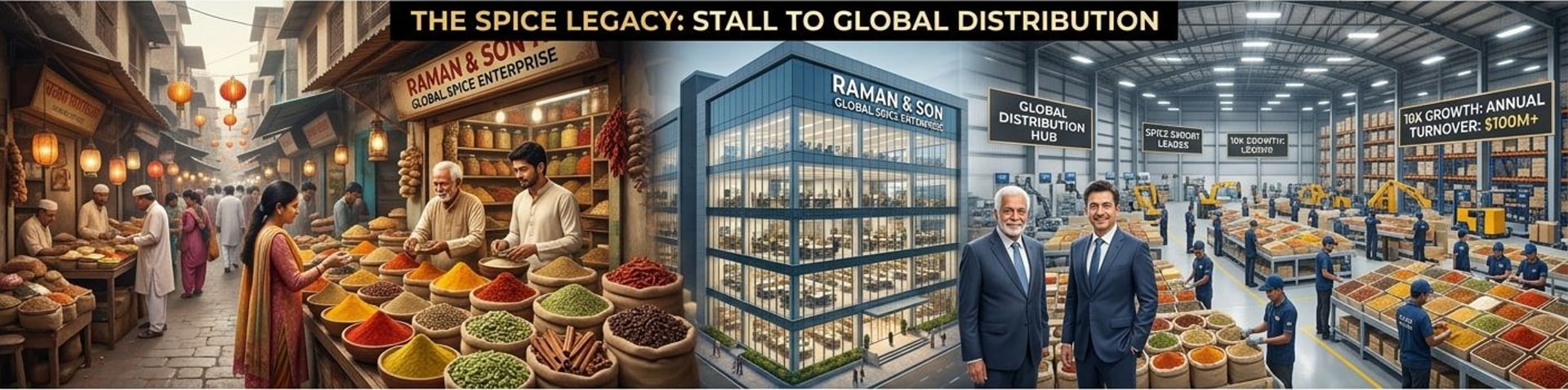

The Four Pillars That Separate Growing Families from Stagnating Ones
After 16+ years of working with Indian family businesses, I have identified four pillars that consistently separate the ones that scale from the ones that stagnate. These are not theories from a textbook. They are patterns I have observed across 100+ families, across industries, across generations.
Pillar 1: Family Governance — Rules Before Conflict
The families that scale are those that build their governance structures before they need them — not after a crisis forces their hand. A family constitution, a family council, clear policies on how family members enter and exit the business, how decisions are made, how conflict is resolved. These are not signs of distrust. They are signs of maturity.
The families that stagnate are those who believe that love and loyalty are enough. They are not. Not when there is money, power, and legacy at stake.
Pillar 2: Professionalisation — Letting Competence Lead
There is a moment in every growing family business when the family can no longer run everything themselves. The businesses that scale are those that recognise this moment early — and bring in professional management without losing their family culture and values.
The businesses that stagnate are those where every senior position is held by a family member, where accountability is avoided because it means holding a relative responsible, where the best non-family employees eventually leave because they see no path forward.
Pillar 3: Aligned Vision — One Direction, Not Many
I have seen businesses with ₹500 crore in revenue and four different people pulling it in four different directions — each one certain that their direction is the right one, each one a family member who cannot be easily overruled. The businesses that scale have invested in building a shared vision. Not a vision imposed by the patriarch. A vision co-created by the family — so that everyone has ownership of the destination.
Pillar 4: Harmony Systems — Prevention Before Cure
The most expensive thing a family business can do is wait for a conflict to explode before addressing it. The families that scale are those that have built systems for ongoing harmony — regular family meetings, structured conversations, clear channels for raising concerns. Not because they are conflict-free, but because they have learned that harmony is not the absence of disagreement. It is the ability to disagree well.
The Real Story Behind Every 10x Business
When I think about the family businesses I have helped scale — some of them 2x, some 3x in just 2-4 years — the transformation never started with a new market strategy or a new product line. It always started with a conversation that had been avoided for years.
It started with a father finally telling his son: "I am proud of what you are building. I trust you to lead this forward."
It started with two brothers agreeing, for the first time, on what each of them actually wanted — not from the business, but from their lives.
It started with a daughter-in-law being given a real role — not a ceremonial one — and discovering that she had ideas and energy that the business desperately needed.
It started with a family sitting together and asking: what do we actually want this business to look like in 10 years? And who do we want to be to each other, along the way?
Business scale is the outcome. Family alignment is the engine.
You cannot have one without the other — not sustainably, not in an Indian family business context.
Where Do You Stand Today?
If you are reading this and your business has been stuck at the same turnover for 3, 4, or more years — ask yourself honestly: Is the ceiling in the market, or is it in the family?
If your next generation is talented but quiet at the table — ask yourself: Have we created a space where they can truly lead, or are we inadvertently keeping them waiting?
If you have been putting off a difficult conversation with a business partner who is also your brother, your father, your spouse — ask yourself: How much is that silence costing the business?
The journey from ₹100 crore to ₹1000 crore is absolutely possible for Indian family businesses. I have seen it happen. I have helped make it happen. But the path always runs through the family first.
About the Author: Sunil Soni is a leading Indian family business consultant with 16 years of experience and research across 850+ Indian family businesses worldwide. He is the founder of IFBN Consultants, working with business families on governance, succession, next generation development, conflict resolution, and business scaling.
Tags: Indian family business, family business scaling, succession planning India, family business governance, family business consultant India, how to grow family business, next generation leadership, family conflict resolution, business harmony
Ready to start a conversation?